
Testbed environments
The datasets are generated using a combination of real world, simulated and hybrid network environments. This approach enables the datasets to capture realistic network behaviour while providing the scale, flexibility and repeatability needed for AI/ML development and benchmarking. Together, these environments provide a complementary approach to sovereign dataset generation: combining real-world fidelity, simulation-driven scale and hybrid flexibility to support the development, validation and benchmarking of AI/ML-based 5G RAN optimisation solutions.
Real world environment
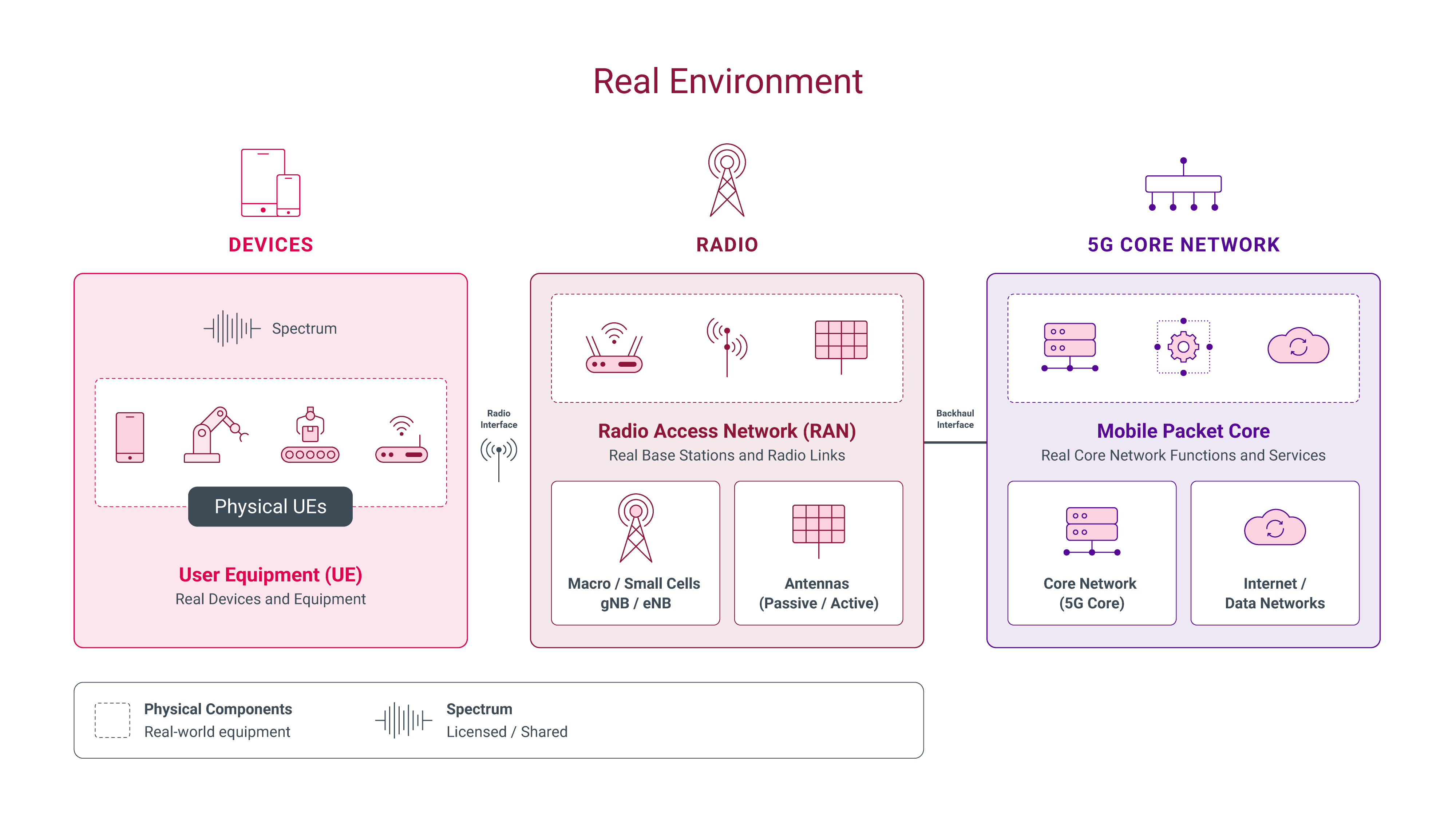
Real-world 5G RAN components and network infrastructure are used to generate datasets from representative network conditions. To support this, Digital Catapult has deployed an indoor Standalone (SA) Private 5G reference network at its premises in King’s Cross, London, alongside an outdoor SA Private 5G network in Fulham. The JOINER platform complements these capabilities by providing access to distributed outdoor SA Private 5G network facilities, enabling data collection and real-world experimentation across diverse network environments.
These reference networks provide real-world measurements and performance characteristics by capturing the behaviour of the RAN under different traffic profiles, user distributions, mobility patterns, and network configurations. As such, they serve as an important benchmark for validating the accuracy and relevance of simulated data.
Simulated environment
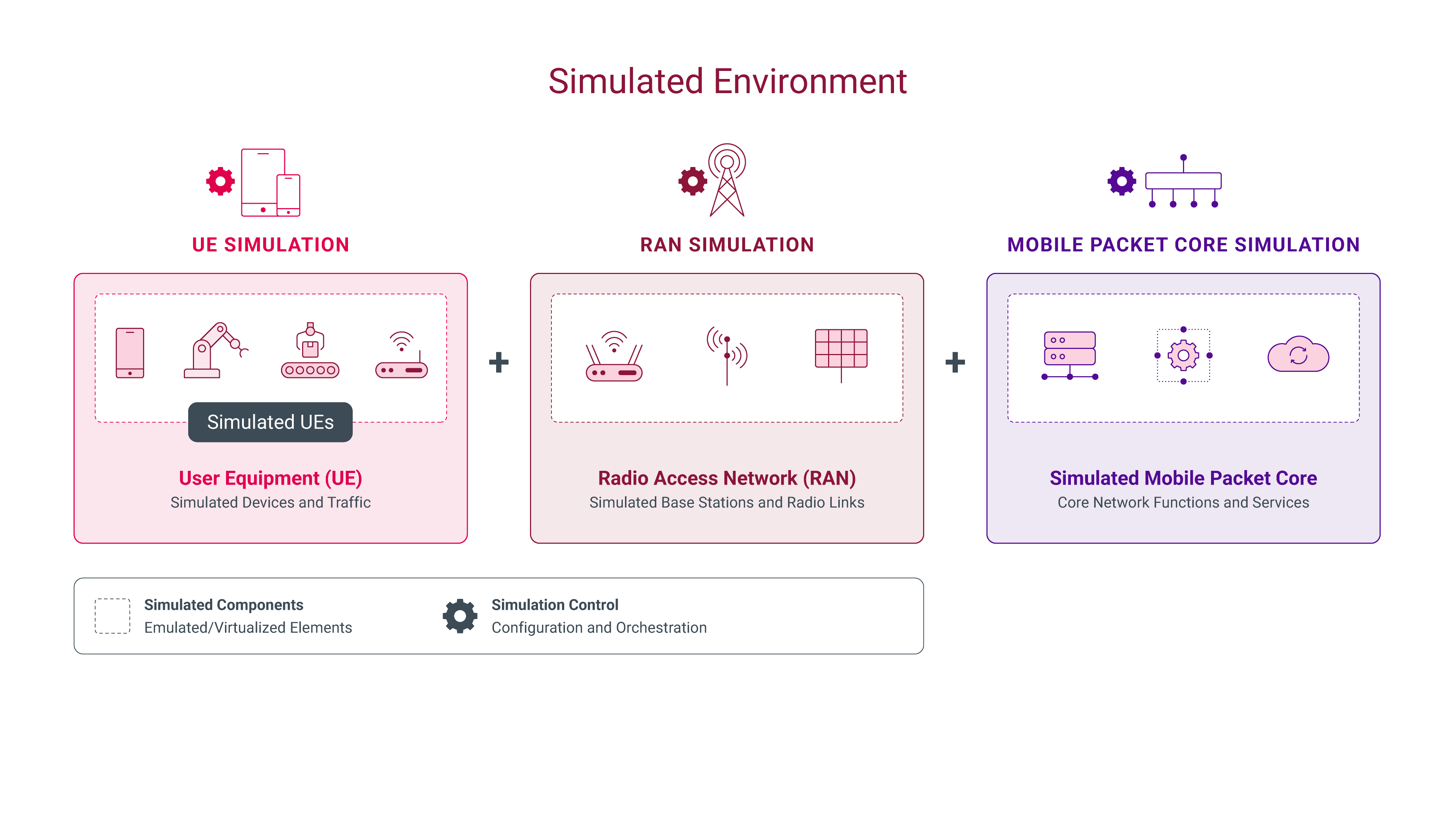
A fully simulated environment uses simulated UE devices, RAN and mobile packet core components to generate large volumes of controlled and repeatable network data. Network conditions, traffic patterns, UE behaviour and RAN configurations can be systematically varied to create diverse scenarios that may be difficult, costly or time-consuming to reproduce in a physical network. This enables efficient generation of datasets for AI/ML model training and benchmarking.
Hybrid environment
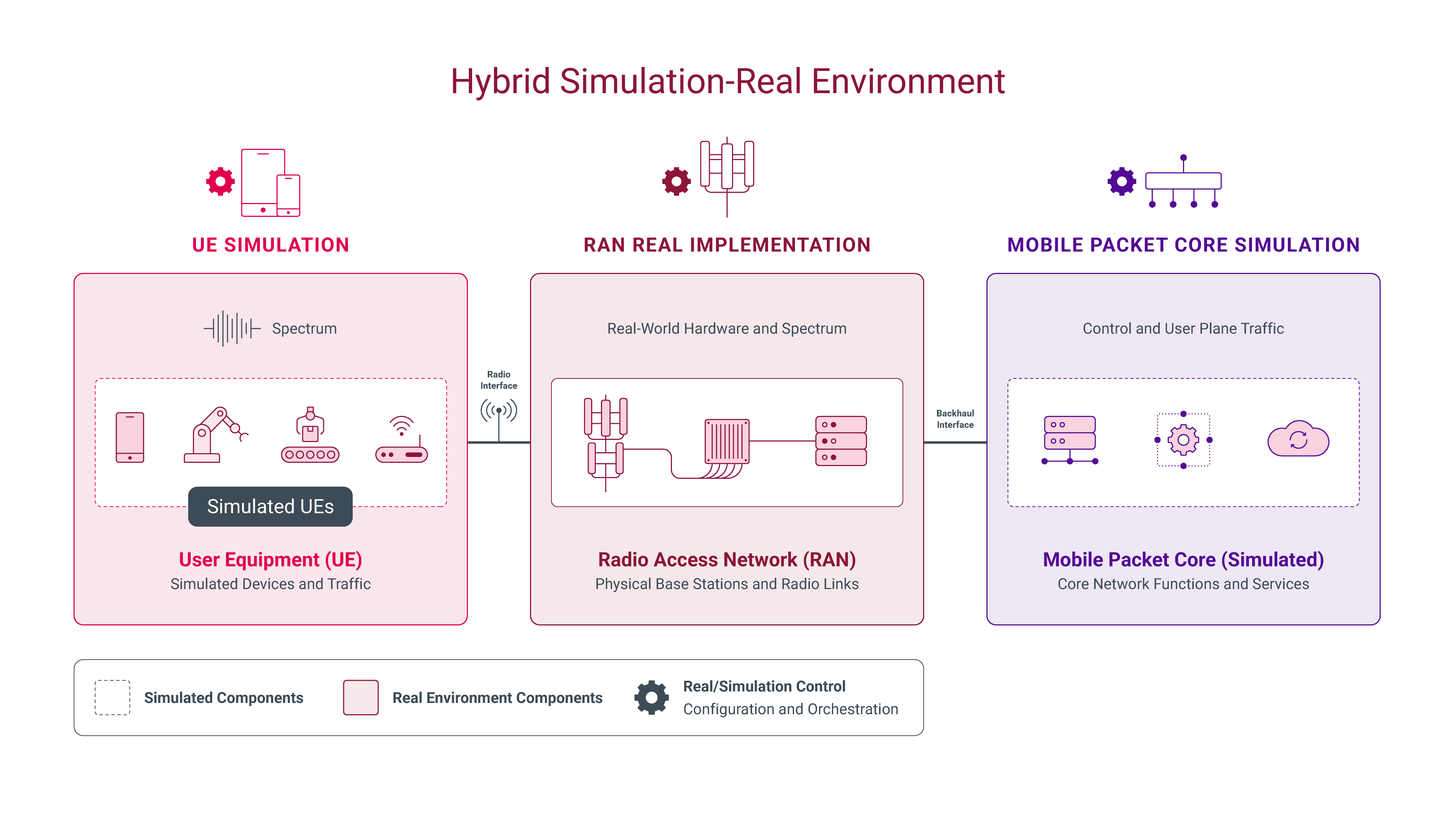
The hybrid environment combines real RAN infrastructure with simulated UE and/or mobile packet core components, providing a balance between real-world network behaviour and the flexibility of simulation. This enables datasets to capture realistic RAN characteristics while allowing traffic, UE populations, network conditions and core-network behaviour to be varied in a controlled and repeatable manner.